
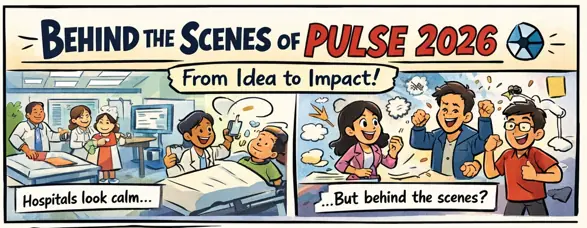
Hospitals and healthcare systems may appear structured and precise on the surface, but innovation within them often begins in moments of uncertainty, collaboration, and rapid iteration. Events like PULSE 2026 bring these unseen processes into motion, where ideas are not just presented but built, tested, and refined under pressure.
One week before PULSE 2026, our journey truly began.
We received an invitation from the Directorate of Medical Education and Research (DMER), recognising our contribution to healthcare innovation. What followed was not preparation in the traditional sense but a transition—from working on ideas independently to shaping them into solutions ready for real-world evaluation.
Building the Foundation
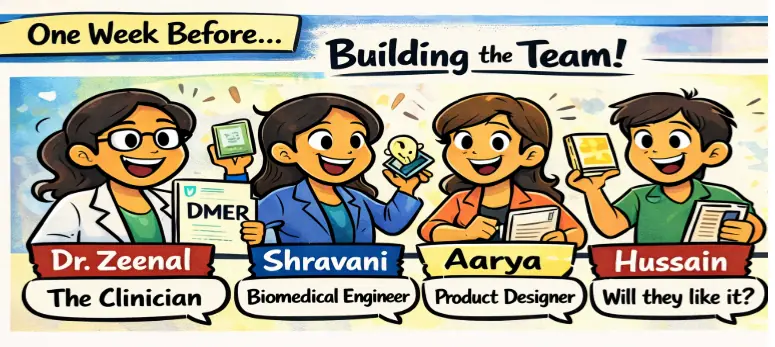
Our team was structured across four distinct pillars, each contributing a critical layer to our projects:
- Dr. Zeenal is leading the medical domain, grounding every idea in clinical relevance
- Shravani focuses on biomedical integration, bridging healthcare needs with technical feasibility
- Aarya shaping product design, translating concepts into usable solutions
- Hussain is refining the product experience, ensuring functionality meets user interaction
Unlike conventional teams, we operated with distributed ownership. Each member independently handled their domain while aligning continuously with the larger vision. This allowed parallel progress across multiple directions.
Managing Multiple Innovations
A defining challenge was that we were not developing a single solution—we were working on four parallel projects. Each required its own research, validation, and presentation strategy.
This introduced a layer of complexity: prioritisation.
Time became the most critical constraint. Decisions had to be made quickly—what to refine, what to simplify, and what to present. The process involved constant iteration, where ideas evolved through discussion, feedback, and rapid restructuring.
Rather than slowing us down, this multi-project approach forced clarity. It pushed us to identify the core value of each idea and communicate it effectively.

The Reality Behind Preparation
Behind every polished presentation lies a less visible reality—late discussions, last-minute changes, and continuous problem-solving. The week leading up to PULSE was defined by:
- Rapid prototyping and restructuring
- Aligning technical feasibility with clinical needs
- Simplifying complex ideas into clear narratives
- Coordinating across different domains under time pressure
These behind-the-scenes efforts are where innovation truly takes shape—not in the final pitch, but in the process leading up to it.
More Than an Event
PULSE 2026 was not just a platform to showcase solutions. It was an environment that simulated real-world innovation challenges—limited time, high expectations, and the need for interdisciplinary collaboration.
For our team, the experience reinforced a key understanding:
innovation is not only about generating ideas, but about executing them effectively within constraints.
Looking Ahead
As healthcare continues to evolve into a more integrated and innovation-driven field, experiences like PULSE highlight the importance of collaboration across disciplines. Medical insight, engineering logic, and design thinking must come together to create meaningful solutions.
Behind the scenes of PULSE 2026, we did not just prepare projects—we built systems, strengthened teamwork, and learned how to translate ideas into impact.
And in many ways, that journey mattered more than the final outcome.