
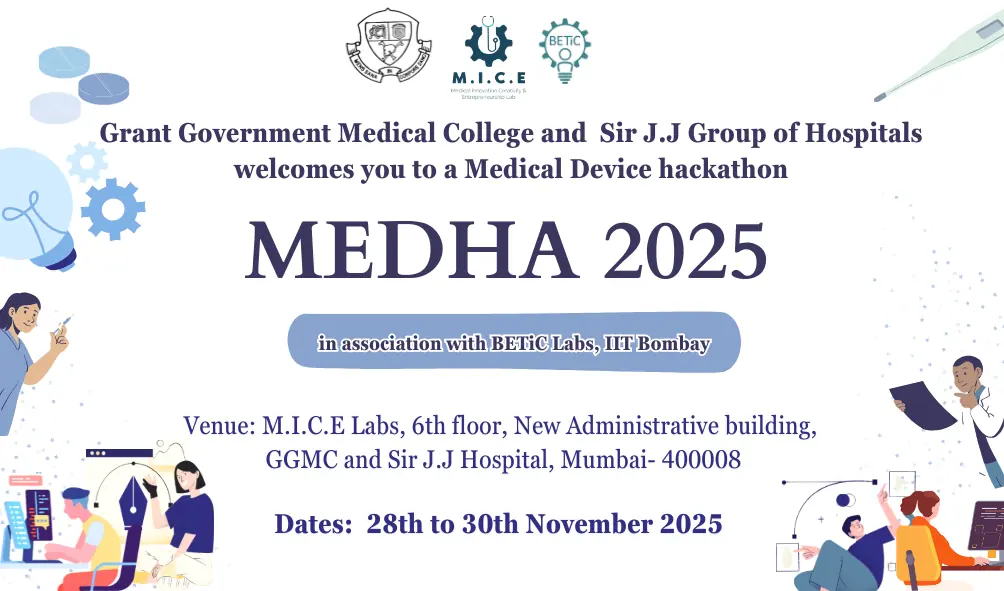
Grant Government Medical College and Sir J.J. Group of Hospitals (GGMC & JJH), Mumbai is one of India’s oldest and most respected government medical institutions and has historically stood at the intersection of clinical excellence, public health service, and medical education. With more than 180 years of clinical legacy, the institute has consistently trained generations of physicians while serving as a pillar of tertiary care for Maharashtra. Over years of service, GGMC & JJH has steadily evolved from being a purely clinical and academic hub to becoming a progressive medical ecosystem that envisions translating real bedside challenges into research, innovation, and technological advancement for public benefit. Aligning with this vision, M.I.C.E Labs (Medical Innovation, Creativity & Entrepreneurship Lab) has emerged as the institution’s innovation nucleus, enabling clinicians, students, and interdisciplinary collaborators to convert unmet clinical needs into tangible prototypes, research opportunities, and healthcare product pathways. M.I.C.E Labs continues to act as a bridge between clinical insight and technical exploration by offering structured mentoring, prototyping support, and innovation-based training opportunities.
Recognizing the critical need for medical technology development within Indian hospitals, GGMC & JJH forged a significant collaboration with BETIC Labs, IIT Bombay: one of the nation’s leading medical device incubators. Through this association, the institution not only gained access to advanced engineering mentorship and design expertise, but also aligned itself with a national innovation network aimed at building India’s capability in affordable and context-driven medical technologies. Medical Device Hackathon (MEDHA) 2025 was, therefore, not just a hackathon; it was a symbolic and functional expression of this vision; a deliberate effort to bring multiple disciplines together inside a live clinical environment and actively work on realistic problem statements emerging from practice. As documented, MEDHA brought together students, clinicians, and professionals to explore unmet clinical needs through interdisciplinary collaboration and innovation.
Through MEDHA 2025, GGMC & JJH, M.I.C.E Labs, and BETIC Labs collectively demonstrated that when medicine, engineering, and design converge under structured guidance, the output is not only creative but clinically meaningful, ethically responsible, and potentially scalable. The success of MEDHA reaffirms the institution’s strategic commitment to becoming a national model for hospital-based, clinician-led medical device development. The three-day event, held from 28th to 30th November 2025, aimed at solving unmet clinical needs to strengthen the healthcare system through innovation, research, design thinking, and team-based problem-solving.
The event witnessed enthusiastic participation and overwhelming support from leadership across various departments. It was graced by key dignitaries including the Honorable Joint Director of DMER Maharashtra, Dr. Vivek Pakhmode, Dean of GGMC & Sir J.J. Group of Hospitals: Dr. Ajay Bhandarwar, Medical Superintendent of GGMC & JJH: Dr. Sanjay Surase, Vice Dean PG: Dr. Gajanan Chavan, Vice Dean UG: Dr. Chhaya Valvi, along with HoDs, faculty members, clinicians, student representatives and invited delegates. Their presence, insights, and encouragement elevated the spirit of innovation and marked a significant milestone in the institution’s journey towards structured medical device development.
A registration fee of ₹1500 per participant was collected from the registered delegates. A total of 36 participants formed the cohort, comprising 18 medicos (9 UG and 9 PG), 9 engineers, and 9 product designers, forming 9 interdisciplinary teams. Each team included 2 medical participants, 1 engineer, and 1 product designer, fostering strong inter-domain collaboration. A total of 22 problem statements were sourced from clinicians at Sir J.J. Hospital, of which 18 were shortlisted and presented to the teams after preliminary screening. The event also received excellent support from 8 students’ council members (MBBS Students of GGMC) who contributed to logistics, design, decor, documentation, photography, PR, media and helped streamline the entire hackathon process.
Day 1: Inauguration, Orientation & Team Formation
The Day 1 activities commenced at 7:30 AM with an on-site registration process followed by ice-breaker activities to foster interaction and team bonding. The Inauguration Ceremony took place at the Surgery Conference Hall (6th Floor, Main Hospital Building, Sir J.J. Hospital) in the presence of dignitaries. As a gesture of sustainability and personalization, invited guests were gifted a 3D-printed pen stand and an indoor plant. This was followed by structured presentation of the unmet clinical needs submitted by clinicians in the form of videos and brief summaries. Delegates voluntarily formed 9 teams based on their networking, interests, and alignment with the problem statements. After much discussion, each team selected one primary problem and immediately began preliminary research, literature review, and internal brainstorming. The first day concluded at 6:00 PM after all teams finalized their problem statements.
Day 2: Research, User Immersion, Mentorship & Prototype Fabrication
Day 2 began at 7:30 AM with high energy. Teams continued deep-dive exploration of their selected problems and were provided structured access to clinical mentors and domain experts. Teams interacted directly with clinicians, nurses, hospital staff, and senior surgeons to validate their assumptions, understand the on-ground challenges, workflow patterns, and existing technology gaps. Dedicated full-time mentors from both medical and engineering domains, along with additional experts from software and hardware specialization, were present throughout the day to support concept refinement, feasibility assessment, and solution direction. The mentorship exposure helped teams solidify their problem scope and ideate practically viable solutions. Teams then moved into structured brainstorming, design visualization, CAD sketching, and early-phase prototype fabrication. By evening, all teams successfully submitted the first set of deliverables including a team website, pitch deck, and a prototype model. To keep engagement exciting, fun mini-competitions were organized such as fastest problem selection, fastest prototype build, and the best team website, with giveaways presented as tokens of appreciation.
Day 3: Final Jury Presentations & Awards
The final and most awaited day hosted the pitch presentations in front of an esteemed interdisciplinary jury. Jury members included Dr. Mannikantha (Dept. of General Surgery — GGMC & Sir J.J. Hospital), Ms. Mena Malgaonkar (ATLAS Skills University), Mr. Vinod Arya (Designer and Simulation Manager, BETIC Labs, IIT Bombay), and Mr. Anil Mehta (Incubator Manager, Vidyalankar Institute of Technology, Wadala). Each team received 7 minutes for presentation and 7 minutes for Q&A, where originality, user-centricity, utility, design logic, manufacturability, safety, and clinical significance were assessed. After rigorous deliberation, two teams secured a tie for First Place — those working on Stroke Identification and Central Line Fixation — while Acoustic Uroflowmeter was awarded Runner-Up. Medals were conferred to all three teams by M.I.C.E Labs as a recognition of their outstanding effort. Additional special recognitions included:
- Fastest selection of problem statement: Continuous BP Measurement Team
- Fastest prototype building: Acoustic Uroflowmetry Team
- Best website: Continuous BP Measurement Team
The winning and runner-up teams were further selected to present their innovations at BETIC Labs, IIT Bombay on 4th January 2025, in the form of a conference-style presentation and poster submission, respectively.
The event also increased awareness of medical device innovation among faculty, space utilization of the hospital’s infrastructure for innovation training, integration between pre-clinical, clinical, and engineering domains, as well as recognition for GGMC & JJH as an emerging innovation ecosystem. Most importantly, MEDHA created a pipeline of multiple early-stage device concepts that can be refined, validated, and potentially incubated through the M.I.C.E Labs–BETIC partnership.
Website Links of the Pitches prepared by the Teams:
| Team Number | Problem Statement Keyword | Website Link |
| Team 1 | Diabetic Foot Digital Monitoring | https://footguardianteam1.framer.website/ |
| Team 2 | Fundoscopy Projection | https://oculux.tiiny.site/ |
| Team 3 | Continuous Blood Pressure Monitoring | https://vasync.framer.website/ |
| Team 4 | Objective PPH Quantification | https://www.canva.com/design/DAG6JKuP6a0/xkVzl36-AJi7QlwAXGkdcw/edit?utm_content=DAG6JKuP6a0&utm_campaign=designshare&utm_medium=link2&utm_source=sharebutton |
| Team 5 | Smart OT Sterility Indication | https://www.canva.com/design/DAG6GUkscVU/REdKnRzf6YxwXMdI2Jt__A/edit?utm_content=DAG6GUkscVU&utm_campaign=designshare&utm_medium=link2&utm_source=sharebutton |
| Team 6 | Patient Progress Portal | https://shirkeshruti23.wixsite.com/the-nexus-band |
| Team 7 | Stroke Workflow System | https://strokefast.vercel.app/ |
| Team 8 | Enhanced Central Line Fixation | https://poojavalotia11.wixstudio.com/cathshield |
| Team 9 | Acoustic Uroflowmetry | https://urosonic.framer.website/ |
PROPOSED FUTURE ROADMAP
The success and learnings from MEDHA 2025 have paved a strong foundation for the institution’s long-term goal of establishing a predictable medical device innovation pipeline within GGMC & JJH. Going forward, M.I.C.E Labs plans to identify at least 4-5 promising projects annually for continued development through technology mentorship, CAD design, prototyping assistance and clinical validation. We also intend of generating high quality research papers on the unmet clinical need and the proposed solution. The institution intends to strengthen linkages with BETIC Labs, IIT Bombay to enable dual-site prototyping, access to advanced simulation facilities, co-supervision for translational research projects and incubator support for selected innovations that demonstrate feasibility. MEDHA is also planned to become an annual signature event, with increasing participation from other medical colleges, engineering institutes, and design schools across Maharashtra. Future editions may include more structured masterclasses, incubation pitches, seed-grant competitions, and early-stage patent drafting workshops.
The roadmap also includes initiating clinical innovation fellowships for residents, pilot-testing select MEDHA prototypes within relevant departments, seeking government research grants, and building official channels for collaborative publications and conference presentations. Over time, MEDHA is expected to evolve from a hackathon into a complete continuum of medical device development; from unmet need discovery and concept iteration to pre-clinical prototyping, safety testing, regulatory refinement and commercialization. Lastly, a national level conference focusing on Medical Device Innovation in various domains of Medical field using Industry-Academia perspective and collaboration. The institution ultimately envisions harnessing its rich clinical exposure and diverse case volume to build breakthrough device technologies that are clinically relevant, economically viable, and scalable across Indian healthcare systems.
Photos of MEDHA 2025