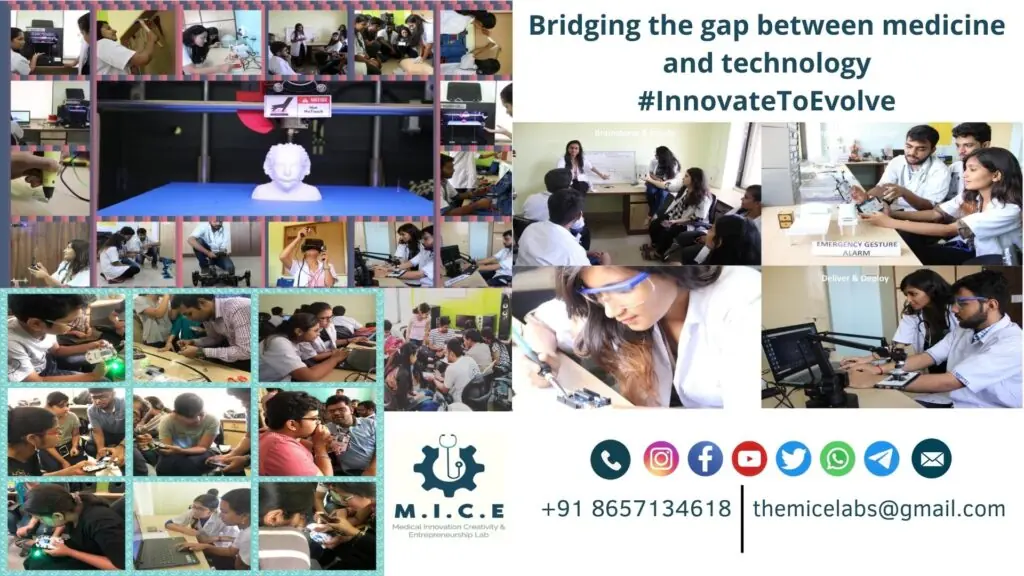
At the Medical Innovation Creativity & Entrepreneurship (M.I.C.E) Labs, every milestone has been shaped not just by ideas, but by people willing to persist within a complex healthcare ecosystem. Over the past years, our journey has been closely guided by the vision and commitment of our Program Manager and Senior Innovation Mentor, Dr. Zeenal Punamiya, whose experience within the lab offers a rare, honest perspective on what it means to build innovation inside a government medical institution.
Beginning Without a Blueprint
When M.I.C.E Labs was conceptualized, there was no predefined structure, funding model, or roadmap for innovation within the institution. As our Innovation Mentor often reflects, the initial phase was less about outcomes and more about asking a fundamental question: Can innovation be nurtured meaningfully within a government medical college and hospital?
Working within administrative frameworks, limited resources, and academic pressures, the early years demanded adaptability, patience, and continuous experimentation. The focus was not on rapid success, but on building trust, relevance, and a sustainable culture of problem-solving.
Learning to Build with Constraints
From the mentor’s perspective, constraints were not barriers but defining features of the ecosystem. Innovation at M.I.C.E Labs evolved around real clinical environments, real patient needs, and real system limitations. Students and clinicians were encouraged to observe deeply, question assumptions, and design solutions that respected ground realities rather than ideal scenarios. Over time, this approach shaped a generation of learners who were not just solution-oriented, but context-aware; a quality often missing in conventional innovation models.
People Before Prototypes
One of the strongest reflections from our Innovation Mentor has been that innovation at M.I.C.E Labs was never just about products or technology. It was about people. Across hackathons, workshops, late-evening brainstorming sessions, and failed prototypes, the lab became a space where students developed confidence, resilience, empathy, and leadership. Many arrived uncertain of their creative abilities and left with clarity about their role as future healthcare innovators. The mentor’s journey has been deeply intertwined with watching this transformation unfold; often quietly, and always organically.
What These Years Have Taught Us
Looking back, the journey has reinforced several core learnings:
- Innovation can thrive in public healthcare systems when intent is strong
- Mentorship without hierarchy enables creativity and ownership
- Failure, when normalized, becomes a powerful teacher
- Sustainable innovation is built slowly, through consistency rather than scale
For our Innovation Mentor, the most meaningful outcomes were rarely measurable; they were visible in mindset shifts, collaborative spirit, and the confidence with which students began to engage with real-world healthcare problems.
Looking Ahead
As M.I.C.E Labs continues to evolve, these reflections serve as a compass rather than a conclusion. The next phase is not about moving away from our roots, but about strengthening them, documenting our learnings, expanding interdisciplinary collaboration, and continuing to mentor innovation that is grounded, ethical, and impactful.
This journey, as seen through the eyes of our Innovation Mentor, stands as a reminder that meaningful change in healthcare does not always begin with resources; it begins with belief, persistence, and people willing to build despite uncertainty.
#innovation #WomeninSTEM #MadeinIndia #Healthcare #MedicalInnovation #HealthcareInnovation #GovernmentHealthcare #PublicHealthSystems #InnovationInHealthcare #InnovationMentorship #InnovationJourney #BuildingFromWithin #MentorReflections #LeadershipInHealthcare #MedicalEducation #ClinicianInnovators #StudentInnovation #HealthcareSystems #DesignThinkingInHealthcare