
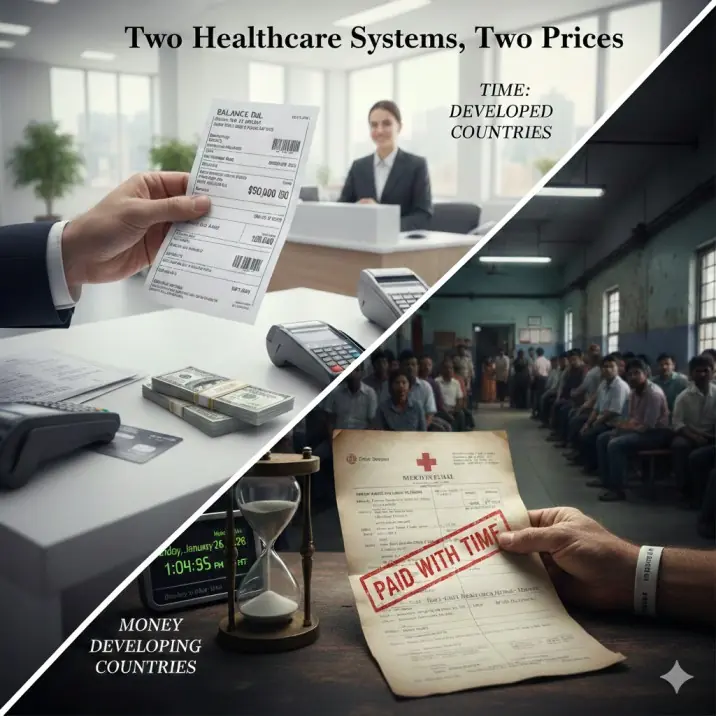
Healthcare costs are usually measured in currency: hospital bills, insurance premiums, and public spending. Yet one of the most expensive costs in modern healthcare is not financial.
It is time.
In many healthcare systems, particularly those that aim for universal coverage, time has replaced money as the primary rationing mechanism. Patients wait for appointments, investigations, and surgeries. Weeks become months. Months become years.
This waiting is treated as administrative delay, not clinical harm.
Innovation has responded accordingly. Digital queues, appointment systems, and workflow automation have been developed to manage waiting more efficiently. But innovation has focused on organizing delay rather than eliminating it.
Technology has optimized waiting lists instead of questioning them.
Time is not neutral in medicine. Disease progresses. Pain accumulates. Anxiety deepens. When care is delayed, outcomes worsen. Yet time remains invisible in most healthcare innovation metrics.
In contrast, healthcare environments that prioritize speed—often out of necessity—treat time as clinically valuable. Rapid diagnostics, same-day consultations, and decentralized care models emerge. Innovation focuses on reducing friction rather than managing volume.In such systems, innovation is not always sophisticated. It is practical: mobile labs, point-of-care tests, simplified procedures, and task-shifting models. These innovations reduce time-to-treatment even if financial costs remain high.
This reveals a profound truth: Healthcare innovation is shaped not by technology alone, but by what the system considers costly.
If money is the cost, innovation targets affordability. If time is the cost, innovation targets scheduling. Rarely does innovation target suffering itself.
A truly patient-centered healthcare innovation would measure success not in throughput or efficiency, but in how quickly it restores function, dignity, and relief.
Time lost to illness cannot be reimbursed. Yet it remains the least innovated variable in healthcare.
Until healthcare systems treat time as a medical outcome rather than an administrative inconvenience, innovation will continue to solve the wrong problems.
#TimeInMedicine #HealthcareDelays #InnovationForPatients #CareDelivery #HealthTech #PatientSafety #HealthcareReform