
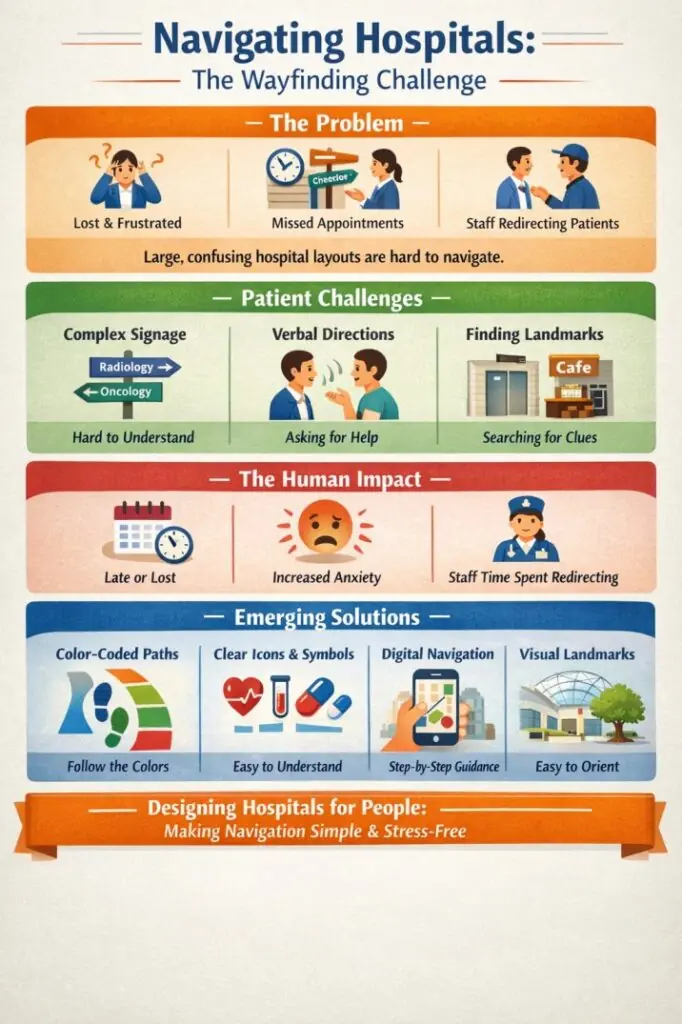
Hospitals are designed to deliver care, but navigating them can be surprisingly difficult. For many patients, especially those visiting large hospitals for the first time, simply finding the correct department can be stressful and confusing. From diagnostic centers to outpatient departments, pharmacies, and laboratories, hospitals often contain dozens of specialized units spread across multiple floors and wings. Without effective navigation systems, patients can easily get lost.
The Wayfinding Challenge
Hospital navigation systems typically rely on written signage, floor directories, and department names. While these systems work for regular visitors or hospital staff, they may not align with how many patients actually understand and move through unfamiliar spaces. Grassroots patients often rely on:
• Verbal directions
• Landmarks within spaces
• Asking staff or other visitors for help
When signage relies heavily on written instructions or unfamiliar terminology, patients may struggle to interpret directions.
The Human Impact
Confusing navigation systems can have real consequences. Patients may arrive late to appointments, miss important departments, or spend long periods searching for the correct location. For individuals already experiencing stress due to illness, this additional confusion can make hospital visits more overwhelming. Hospital staff also spend significant time redirecting patients who are unable to find their destination.
Emerging Wayfinding Solutions
Many healthcare facilities around the world are beginning to rethink how patients navigate hospital environments. Some hospitals now use color-coded navigation paths, where patients follow specific colors assigned to departments. Others have introduced icon-based signage to make directions understandable regardless of language or literacy levels. Digital tools such as indoor navigation apps are also being explored, providing step-by-step directions within hospital buildings. In some facilities, architects are designing spaces with clear visual landmarks that help visitors orient themselves naturally.
Designing Hospitals that People can Navigate
Effective hospital wayfinding requires designing navigation systems that reflect how people actually interpret space. This means considering:
• Language diversity
• Literacy levels
• Visual recognition
• Stress during healthcare visits
When navigation systems become more intuitive, patients can move through hospitals more confidently and efficiently.
Healthcare accessibility is not only about treatment availability. It is also about ensuring patients can navigate healthcare environments without confusion. By designing clearer, more intuitive wayfinding systems, hospitals can create spaces that support patients from the moment they walk through the door. Because sometimes, the first step to receiving care is simply finding where to go.
#HealthcareAccess #BetterHospitals #HospitalDesign #FutureOfHealthcare #PatientFirst