
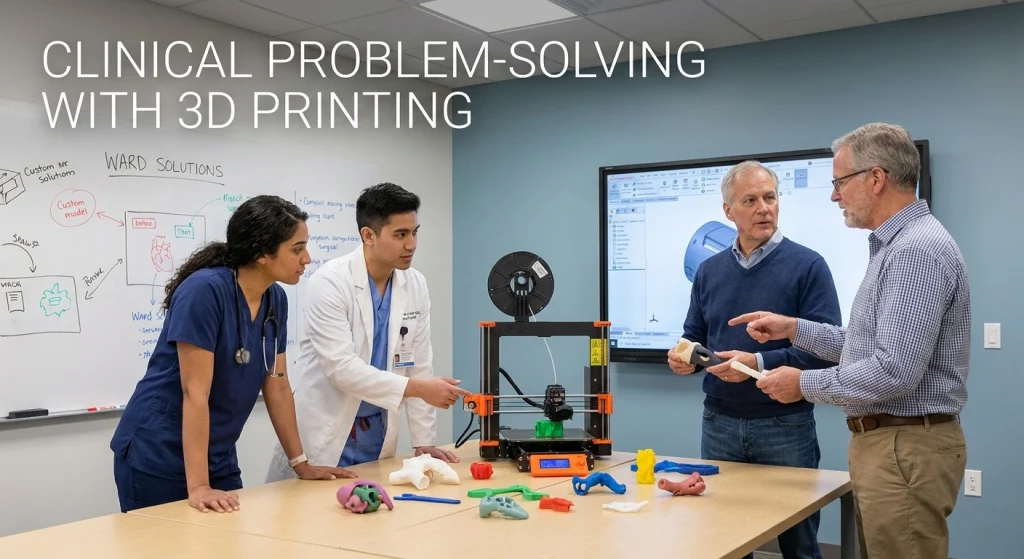
Imagine you’re on your surgery posting in a busy government hospital and the surgeon asks you to create a model of a complex fracture for better surgical planning. With limited resources and time, how could you possibly do that? Enter 3D printing, a technology that is transforming medical practice, even in resource-constrained settings like ours. But how can a medical student actually leverage this technology to solve real problems on the wards?
How Can a Medical Student Actually Start Using 3D Printing in a Government Hospital?
Starting with 3D printing may seem like a daunting task, especially in a government hospital setting. However, the first step is to familiarize yourself with the basics of the technology. 3D printing, or additive manufacturing, allows you to create three-dimensional objects from a digital file. Many government hospitals, like Sir J.J. Group of Hospitals, are integrating this technology into their workflow through innovation labs like M.I.C.E Labs.
At M.I.C.E Labs, facilities like 3D printers are available for students and clinicians. You can begin by participating in a 5-session tinkering course offered by the lab, which focuses on hands-on experience with 3D printing and other technologies. Additionally, engaging with real-world projects such as creating anatomical models for surgical planning can provide practical insights.
Why Is 3D Printing Particularly Useful in Surgical Planning?
3D printing is invaluable in surgical planning because it allows for the creation of patient-specific anatomical models. These models can help surgeons visualize complex cases and plan surgeries with higher precision. For example, at M.I.C.E Labs, projects like SurgoArm have leveraged 3D printing to improve surgical training and planning. By printing a model of a fracture or a tumor, surgeons can rehearse procedures, minimizing surprises during the actual surgery and potentially reducing operation time.
Moreover, these models can be produced quickly and at a fraction of the cost compared to traditional methods. This is especially beneficial in a public hospital setting, where resources are often limited. The use of 3D printing can lead to better outcomes and enhanced patient safety.
What Are Some Practical Applications of 3D Printing for Medical Students?
Medical students can apply 3D printing in several practical ways:
- Creating Anatomical Models: Use 3D printing to create models for study and surgical planning.
- Prototyping Medical Devices: Develop prototypes for low-cost medical devices, like SharpSafe for needle disposal.
- Personalized Prosthetics: Design and print prosthetics tailored to individual patients, which can be particularly useful in orthopedics.
- Surgical Tools: Create custom surgical tools that can be tailored for specific procedures.
Engaging with M.I.C.E Labs projects and courses can provide you with the skills and knowledge to apply 3D printing in these areas effectively.
When Do You Need to Consider Regulatory Approvals for 3D Printed Medical Devices?
When moving from a prototype to actual patient use, regulatory approvals become crucial. In India, the Central Drugs Standard Control Organization (CDSCO) governs the approval of medical devices. Before using a 3D printed device on patients, it’s essential to understand the regulatory pathway.
Typically, simple anatomical models used for educational purposes might not require approval, but devices that come in contact with the patient or are implanted will need thorough testing and regulatory clearance. Collaborating with mentors at M.I.C.E Labs can provide guidance on navigating these regulatory requirements, ensuring that your innovations align with CDSCO standards.
Frequently Asked Questions
Q: Can I use 3D printing to create custom surgical tools?
A: Yes, 3D printing is excellent for creating custom surgical tools. It allows for rapid prototyping and customization, which can be beneficial for specialized surgical procedures.
Q: What software do I need to start with 3D printing?
A: Basic CAD software like Tinkercad or more advanced options like Fusion 360 can be used to create digital models for 3D printing. These programs are essential for designing the objects you wish to print.
Q: Are there any courses for learning 3D printing in medical applications?
A: M.I.C.E Labs offers courses such as “Design Thinking to Prototyping” that cover 3D printing in medical applications. These courses are designed to help you understand both the technical and clinical aspects of 3D printing.
Q: How cost-effective is 3D printing in a government hospital setting?
A: 3D printing can be very cost-effective, especially when creating models and prototypes. The initial investment in a printer is offset by the savings on materials and the reduced need for external manufacturing services.
Q: Can 3D printing be used for educational purposes?
A: Absolutely. 3D printed models are an excellent tool for medical education, allowing students to study complex anatomical structures in a tangible form.
As you approach your next ward round, consider how 3D printing might solve some of the challenges you observe. Sketch a quick prototype idea, or discuss a potential project with your mentor. If you’re at Sir J.J. Hospital, explore the resources at M.I.C.E Labs, where you can transform these ideas into reality. The integration of technology like 3D printing in medicine is not just a theoretical exercise — it’s a practical tool that’s reshaping healthcare in real-time.