
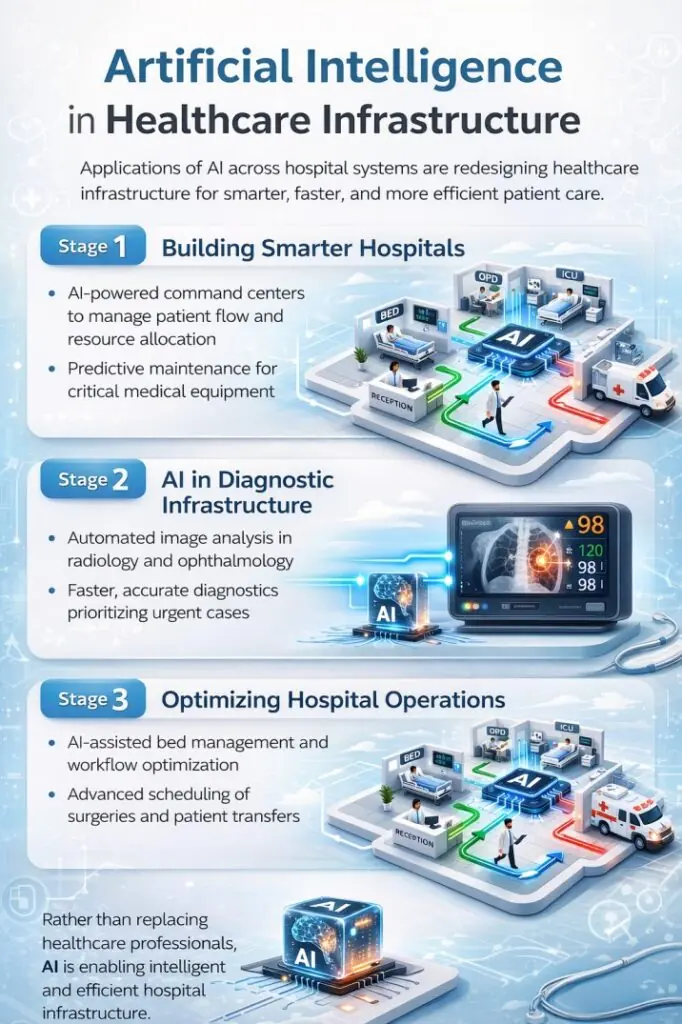
Hospitals today are complex ecosystems. From emergency departments and diagnostic labs to patient wards and administrative systems, every function generates large volumes of data. Managing these interconnected systems efficiently is a growing challenge. This is where Artificial Intelligence (AI) is beginning to reshape healthcare infrastructure.
Rather than replacing healthcare professionals, AI acts as an intelligent layer across hospital systems, enabling faster decisions, improved coordination, and more responsive care environments.
Building Smarter Hospitals
AI is increasingly integrated into hospital infrastructure to support everything from patient flow management to diagnostic analysis and predictive maintenance of medical equipment. One notable example is Johns Hopkins Hospital in the United States, which implemented an AI-powered capacity command center. The system analyzes real-time hospital data, including bed availability, patient admissions, and staff allocation. By predicting patient demand and identifying bottlenecks, the hospital reduced patient transfer delays and improved operational efficiency across departments. Similarly, hospitals are beginning to use AI-driven systems to monitor the status of critical equipment. Predictive algorithms can analyze machine performance data to anticipate failures in devices such as MRI scanners or ventilators. This allows maintenance teams to intervene before equipment downtime affects patient care.
AI in Diagnostic Infrastructure
Another area where AI infrastructure is making a significant impact is medical imaging. At Moorfields Eye Hospital in London, researchers collaborated with technology companies to develop an AI system capable of analyzing retinal scans. The system can identify more than 50 eye conditions with accuracy comparable to expert clinicians. By automatically prioritizing urgent cases, the AI system helps specialists focus on patients who require immediate intervention. Such systems demonstrate how AI can be embedded directly into diagnostic infrastructure to improve both speed and accuracy.
Optimizing Hospital Operations
Beyond diagnostics, AI is also improving hospital operations. Smart algorithms can analyze patient admission patterns, treatment timelines, and discharge data to streamline hospital workflows. For instance, several hospitals in Europe have implemented AI-powered scheduling systems that optimize operating room usage. By predicting procedure durations and identifying scheduling conflicts, these systems reduce idle time and increase surgical capacity. AI also plays a role in managing patient journeys within hospitals. Intelligent routing systems can guide patients through departments, allocate beds more efficiently, and reduce waiting times.
Designing the Hospitals of the Future
As hospitals evolve into data-driven environments, AI will become a foundational component of healthcare infrastructure. From predictive analytics and automated diagnostics to intelligent workflow management, AI is helping healthcare systems become more proactive, efficient, and patient-centered. For healthcare designers, innovators, and administrators, the opportunity lies in integrating these technologies seamlessly into hospital ecosystems—creating spaces where technology supports clinicians and improves the overall patient experience. The hospitals of the future will not just be technologically advanced; they will be intelligently designed systems powered by AI.
#ArtificialIntelligence #AIInHealthcare #HealthcareInfrastructure #SmartHospitals #DigitalHealth #HealthTech #HospitalManagement #HealthcareInnovation #MedicalTechnology #AIApplications #FutureOfHealthcare #PatientCare #HealthcareSystems #InnovationInHealthcare #MICELabs