
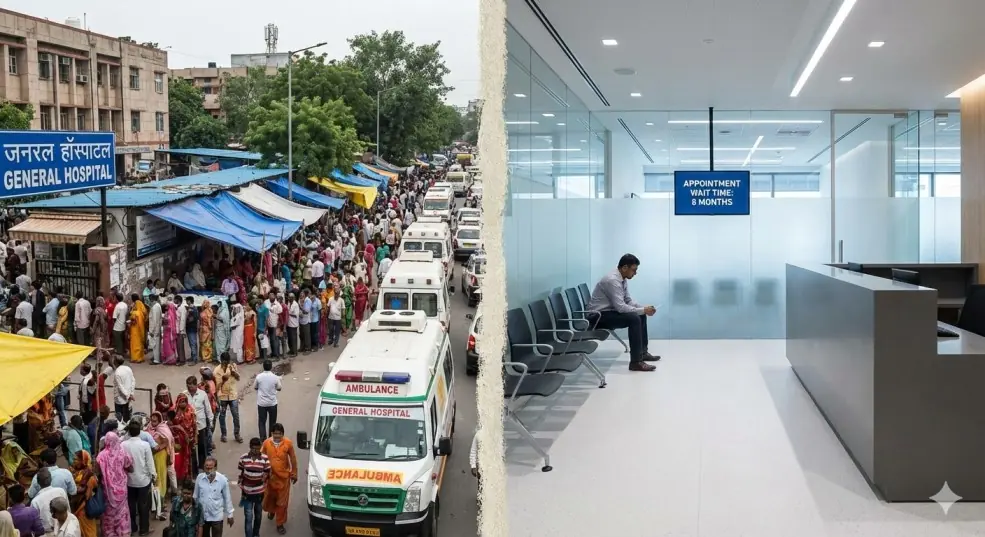
Healthcare systems rarely fail dramatically. They fail quietly through delays, trade-offs, and invisible suffering. When healthcare systems in many developed countries are placed alongside the Indian healthcare system, the contrast is not simply economic. It reflects what each system chooses to ration—and therefore what it chooses to innovate for.
In many developed healthcare systems, care is publicly funded and financially protective. The promise is that no one will be denied treatment because of cost. This shifts the burden away from money and onto time. Access is regulated through referrals, pathways, and waiting lists.
Innovation in such systems often focuses on managing demand: scheduling platforms, digital triage, predictive analytics, and administrative optimization. These innovations improve efficiency, but they rarely shorten suffering. They help systems cope with overload rather than rethink care delivery.
Indian healthcare behaves differently. It is less centralized and far less uniform. Infrastructure is strained, and out-of-pocket expenditure remains high. Yet when illness appears, the system moves quickly. Availability often precedes affordability. Consultations, diagnostics, and specialist opinions are accessible with fewer structural barriers.
Here, innovation arises from scarcity. Low-cost devices, portable diagnostics, and simplified workflows emerge because the system cannot afford delay. Frugal innovation becomes a survival strategy. Hospitals and clinicians innovate in real time to meet overwhelming demand.
This responsiveness comes at a cost. Indian families pay in money. Developed-system patients pay in waiting. Both are forms of rationing.
But these rationing mechanisms shape innovation differently.
When money is scarce, innovation seeks affordability. When time is rationed, innovation seeks efficiency.
Neither automatically seeks compassion.
The deeper question is not which system is better, but which kind of innovation each system encourages. One builds tools to manage queues. The other builds tools to bypass them.
The ideal healthcare system would innovate for both: financial protection and timely care. Until then, innovation remains trapped inside the logic of the system that funds it.
Every healthcare system rations care. Every healthcare system innovates around that rationing. The real challenge is to innovate around human suffering, not just system limitations.
#HealthcareEconomics #InnovationInHealthcare #AccessToCare #TimeVsMoney #HealthPolicy #MedicalInnovation #GlobalHealth