
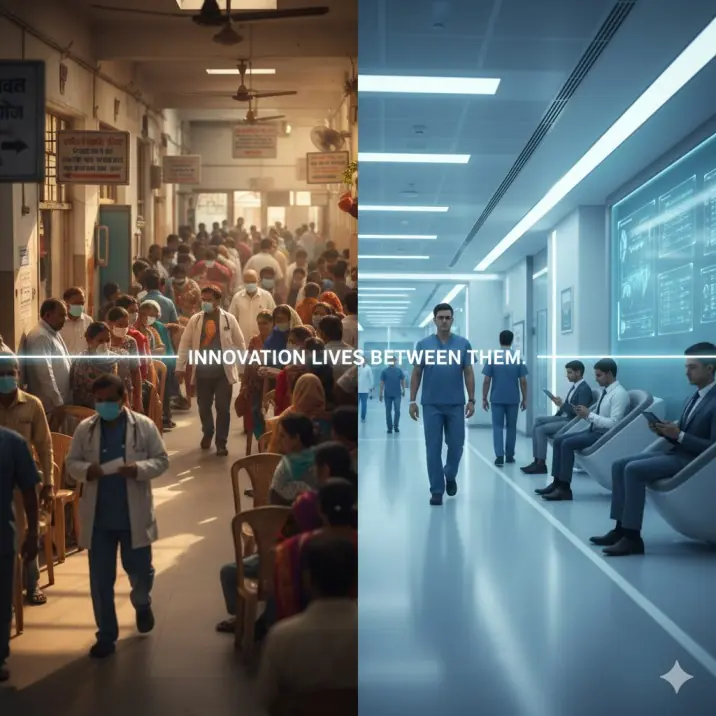
Indian healthcare often looks chaotic. Crowded waiting areas, long queues, hurried consultations, and constant motion give the impression of disorder. The system feels overstretched and noisy.
Healthcare systems in many abroad and developed countries look very different. They appear calm and structured. Appointments are scheduled. Corridors are quiet. Care follows clearly defined protocols.
Yet beneath these surface differences lies a paradox. Indian healthcare moves fast. Many developed healthcare systems move slowly.
The chaos in India is not simply dysfunction; it is a form of responsiveness. High patient volumes and limited resources force the system to act quickly. Diagnostics are arranged promptly. Decisions are made rapidly. Treatment begins early, even if conditions are far from ideal. The system bends to human need.
Innovation in such an environment is driven by necessity. Low-cost devices, portable diagnostics, simplified workflows, and task-shifting models emerge to cope with demand. This is frugal and adaptive innovation—focused on speed and accessibility.
In contrast, healthcare systems in many developed countries are designed around order and safety. Protocols and pathways ensure uniformity and reduce risk. Over time, this has also reduced flexibility. Illness enters a queue. Care moves step by step. Speed is replaced by scheduling.
Innovation in these systems often focuses on optimization: digital records, appointment systems, and automation. These tools improve efficiency, but they frequently organize waiting rather than eliminate it.
This leaves two imperfect models:
- A chaotic system that delivers care but exhausts patients and providers.
- A frozen system that protects processes but delays relief.
The future of healthcare innovation lies between these extremes. Innovation must bring structure without rigidity and speed without disorder. It should focus on:
- faster triage and diagnostics
- flexible care pathways
- low-cost, high-impact technologies
- systems that support clinical judgment
- tools that reduce suffering, not just paperwork
Both systems can learn from each other. Indian healthcare needs innovation that adds stability and financial protection without slowing care. Developed healthcare systems need innovation that restores responsiveness and adaptability without sacrificing safety.
Healthcare does not need to choose between chaos and control. It needs to innovate toward a system that is agile, safe, and humane.
True innovation in healthcare will not be measured by how orderly hospitals look or how advanced the technology appears. It will be measured by how quickly and compassionately care reaches those who need it.
#HealthcareDesign #AdaptiveHealthcare #FrugalInnovation #SystemInnovation #HealthcareTransformation #GlobalHealthcare #MedicalInnovation