
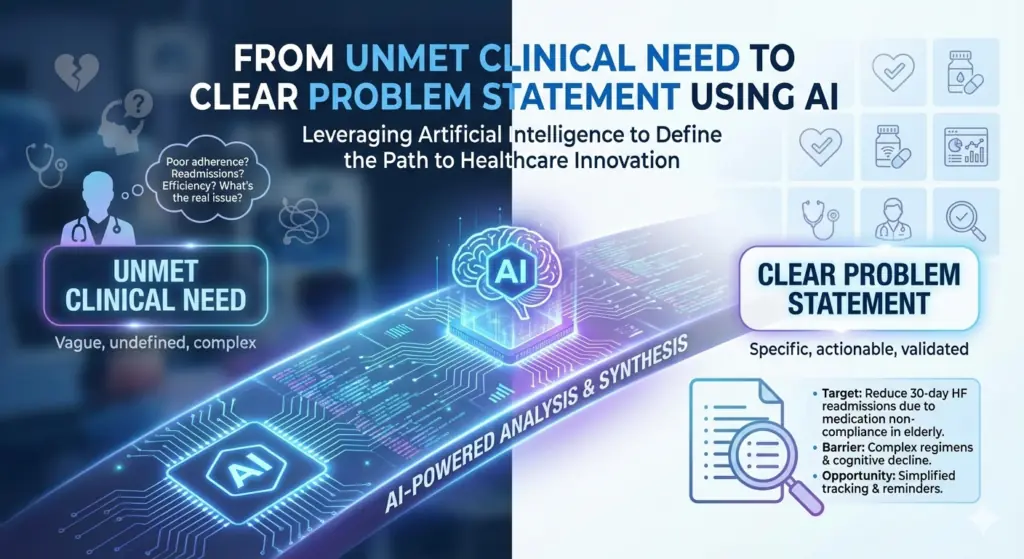
Identifying an unmet clinical need is only the beginning. The real turning point in innovation happens when a vague problem is converted into a clear, focused, and researchable problem statement. Many healthcare innovations fail not because the idea is weak, but because the problem was never clearly defined.
In clinical settings, problems usually appear as complaints. “OPD is always crowded.” “Patients don’t follow instructions.” “Documentation takes too long.” These are observations, not problem statements. A strong problem statement must be specific, measurable, user-focused, and context-aware. This is where AI becomes extremely useful.
Start by writing your raw observation in simple language. Then use AI tools like ChatGPT, Claude, or Gemini to refine it. For example, input:
“Patients don’t understand discharge instructions and return with complications.”
Ask AI to:
“Convert this into a structured problem statement including who is affected, where it occurs, and why it matters.”
The refined output may look like:
“There is no standardized, personalized, and easy-to-understand discharge communication system for surgical patients in public hospitals, leading to poor compliance and preventable complications.”
Notice the difference. The problem is now:
- Specific (discharge communication system)
- Targeted (surgical patients in public hospitals)
- Outcome-linked (poor compliance and complications)
Next, strengthen the problem statement using AI-assisted validation. Ask AI:
- What evidence supports this issue?
- What are the clinical consequences?
- What economic impact might this have?
- What current solutions exist and why are they insufficient?
Using literature tools like Elicit or Consensus AI, you can quickly gather summaries of studies showing that poor discharge communication leads to higher readmission rates. This adds credibility and transforms your idea from opinion into evidence-backed concern.
A powerful problem statement also includes context. Healthcare in a tertiary government hospital is different from a private urban center. AI can help tailor the statement to local realities. For example, you can prompt:
“Refine this problem statement for a low-resource government hospital in India.”
This ensures the problem reflects infrastructure limitations, patient literacy levels, and system constraints.
Another useful technique is asking AI to apply the “5 Whys” method. Why do patients return with complications? Because they did not follow instructions. Why did they not follow instructions? Because they did not understand them. Why did they not understand them? Because explanations were rushed and not reinforced. This iterative questioning sharpens the core issue.
A well-structured problem statement should avoid jumping into solutions. For example, saying “We need an app for discharge instructions” is premature. The correct approach is to define the gap first. AI can help check whether your statement is solution-biased. Simply ask:
“Does this problem statement contain a proposed solution? If yes, refine it to remove the solution.”
Before moving forward, test your statement against three questions:
- Is it clearly describing a gap?
- Is it focused on a specific user group?
- Is it supported by some evidence or logic?
If the answer is yes, you now have a strong foundation for innovation, research, or quality improvement.
In summary, AI acts as a thinking partner that helps clinicians move from frustration to clarity. It organizes thoughts, validates assumptions, sharpens language, and prevents premature solution design. Instead of asking, “What should we build?”, the better question becomes, “What precisely is the gap we must address?”
When clinicians learn to define problems clearly, innovation becomes structured rather than accidental. A strong problem statement is not just an academic exercise—it is the blueprint for meaningful healthcare change.
#MedicalInnovation #ProblemStatement #HealthcareInnovation #AIinHealthcare #ClinicalResearch #DesignThinking #HealthTech #DigitalHealth #UnmetClinicalNeed #EvidenceBasedMedicine #HumanCenteredDesign #MedEd #InnovationInMedicine #AIforClinicians