
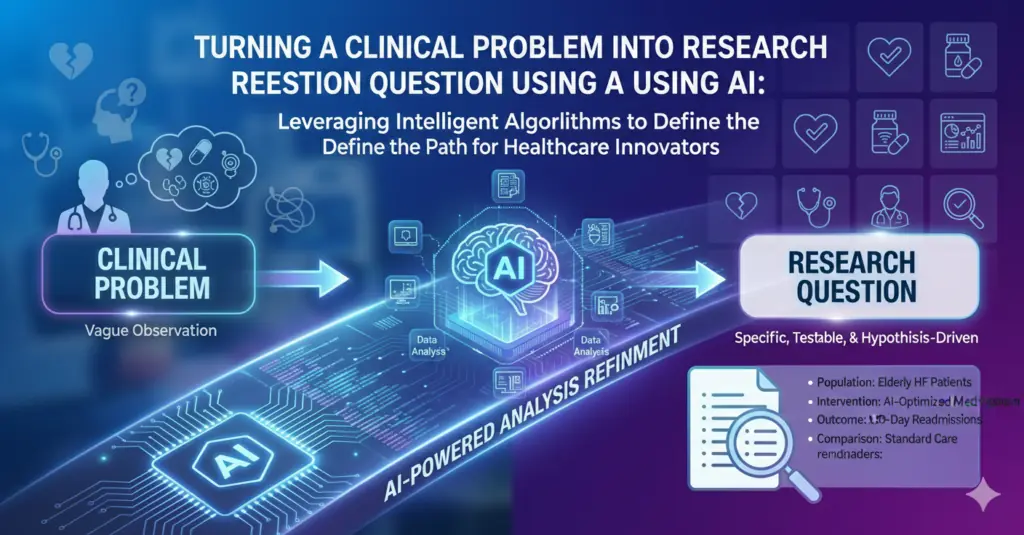
Identifying a problem is powerful. But unless that problem is converted into a structured research question, it remains an idea. Many clinicians struggle at this stage. They have a clear unmet need but are unsure how to frame it into something publishable, testable, and academically strong. This is where AI becomes a practical thinking assistant.
The first shift is from descriptive thinking to investigative thinking. For example, consider this problem statement: “There is no standardized discharge communication system for surgical patients in public hospitals.” This is a clear problem, but it is not yet a research question. A research question must explore relationships, outcomes, comparisons, or measurable impact.
AI tools like ChatGPT, Claude, or Gemini can help structure this transition. By prompting, “Convert this problem statement into 5 possible research questions suitable for a clinical study,” you can generate variations such as:
– Does structured discharge communication reduce 30-day readmission rates in surgical patients?
– What is the impact of personalized discharge education on medication adherence?
– How does digital reinforcement compare with verbal instructions alone?
Notice how each question introduces measurable outcomes.
One of the most useful frameworks in clinical research is PICO (Population, Intervention, Comparison, Outcome). AI can help break your idea into this format. For example, prompt: “Convert this idea into a PICO framework.” The tool will structure it into a research-ready format, clarifying exactly who is studied, what is introduced, and what outcome is measured. This makes protocol writing significantly easier.
AI can also help refine feasibility. Ask: “Is this research question feasible in a government tertiary hospital with limited resources?” This prevents overly ambitious designs. It may suggest observational studies, pilot studies, or questionnaire-based research instead of randomized controlled trials, depending on practicality.
Another powerful use of AI is identifying measurable variables. Many early researchers struggle with defining outcomes. AI can suggest validated scales, measurable endpoints, or surrogate markers. For instance, instead of vaguely measuring “patient understanding,” it may suggest medication adherence rates, readmission frequency, or satisfaction scores.
Literature validation tools like Elicit and Consensus AI can further refine your question. By reviewing similar studies, you can identify gaps where evidence is weak, outdated, or geographically limited. AI summaries allow you to position your question in a way that contributes something new rather than repeating existing work.
Importantly, AI can also stress-test your research question. Simply ask:
– Is this question too broad?
– Is it biased?
– Is it solution-driven instead of exploratory?
– Are there ethical concerns?
This critical feedback strengthens academic quality before submission to ethics committees or journals.
A well-crafted research question transforms innovation into scholarship. It opens pathways for publications, grants, presentations, and structured quality improvement initiatives. More importantly, it ensures that innovation is evidence-based rather than assumption-based.
Clinicians often believe research requires advanced statistical expertise from the beginning. In reality, the most difficult part is clarity of question. Once the question is precise, methodology naturally follows. AI acts as a clarity amplifier—it organizes thoughts, suggests structure, identifies gaps, and improves academic language.
The journey from bedside frustration to research publication follows a clear path: observe a problem, define the unmet need, structure the problem statement, and convert it into a research question. When healthcare professionals master this sequence, innovation becomes systematic and repeatable.
In the era of AI, the barrier to structured research thinking is lower than ever. The responsibility, however, remains deeply human: to ask meaningful questions that improve patient care.
#ClinicalResearch #MedicalInnovation #AIinHealthcare #ResearchDesign #PICOFramework #HealthcareInnovation #EvidenceBasedMedicine #MedEd #HealthTech #DigitalHealth #InnovationInMedicine #AcademicMedicine #AIforClinicians #ResearchMethodology