Medical students often believe innovation is reserved for senior doctors, researchers, or engineers. In reality, students are uniquely positioned to identify unmet clinical needs because they rotate across departments, observe workflows closely, and notice inefficiencies that others may have normalized. With the support of AI tools, identifying multiple unmet needs within a short period becomes structured and achievable.
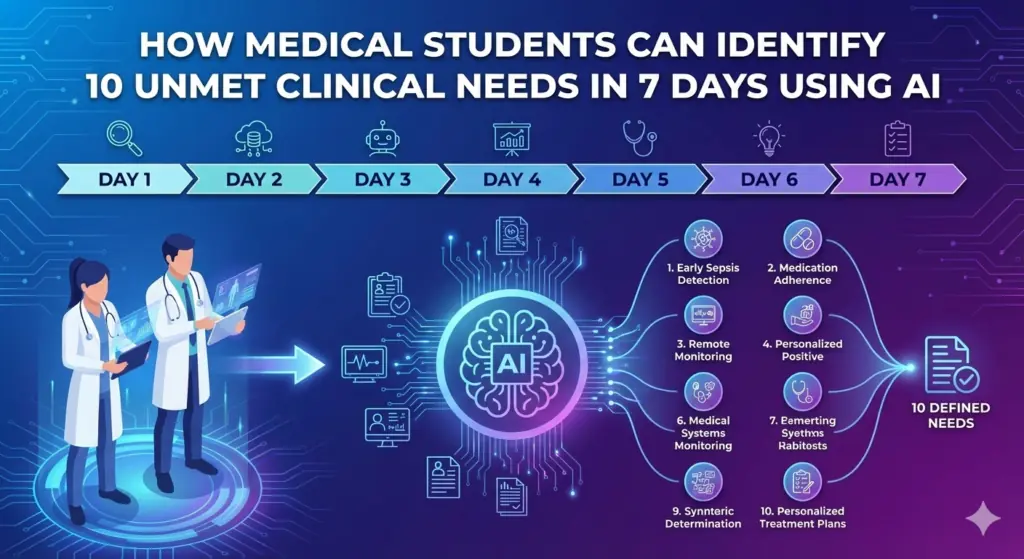
The first step is observation. For one week, students should consciously document daily clinical frustrations. These may include delays in investigations, difficulty explaining procedures to patients, repeated paperwork, poor interdepartmental communication, or patient confusion about medications. The goal is not to judge or criticize but to observe patterns. Maintaining a simple digital log in tools like Notion or Google Docs ensures ideas are captured immediately.
Once raw observations are collected, AI tools such as ChatGPT, Claude, or Gemini can help refine them. Instead of writing “patients are confused,” students can prompt AI to convert that observation into a structured unmet need. For example, “Convert this observation into a clear unmet clinical need in a government hospital setting.” This step transforms vague impressions into defined gaps in care delivery.
On the third and fourth day, students should validate their observations. Using AI-assisted literature tools such as Elicit, Research Rabbit, or Consensus AI, they can quickly determine whether the problem has already been solved or if significant gaps remain. AI summaries save time and help students understand current evidence without reading dozens of full-length papers initially. If solutions exist but are costly, inaccessible, or unsuitable for low-resource settings, the problem may still qualify as an unmet need.
The fifth day should focus on workflow mapping. Using platforms like Miro AI or FigJam, students can visually map where the breakdown occurs in the clinical process. For example, if follow-up loss is common, mapping the patient journey from discharge to review may reveal communication gaps. Visual clarity often reveals hidden inefficiencies that are not obvious in written notes.
On the sixth day, students should measure impact. A short, simple survey created through Google Forms can gather feedback from interns, nurses, or peers. AI tools can assist in drafting survey questions and analyzing results. Even small sample insights can help prioritize which unmet needs are frequent and clinically meaningful.
Finally, on the seventh day, students should shortlist ten structured unmet clinical needs. Each should clearly mention the affected population, setting, gap in care, and consequence. For example: “There is no standardized system to ensure medication understanding among elderly patients in busy outpatient clinics, leading to poor adherence.” This format ensures clarity and future research potential.
By the end of seven days, students will not only have a list of ten unmet clinical needs but also a structured understanding of healthcare gaps. More importantly, they will have shifted their mindset from passive learners to active problem identifiers. AI does not replace clinical thinking; it strengthens it by organizing observations, validating evidence, and refining clarity.
Innovation begins not with invention but with attention. When medical students learn to observe deeply, question systems, validate intelligently, and think ethically, they become future-ready healthcare innovators. AI simply accelerates the journey.
#MedicalStudents #MedicalInnovation #UnmetClinicalNeed #AIinHealthcare #ClinicalResearch #FutureDoctors #HealthcareInnovation #DesignThinking #MedEd #HealthTech #DigitalHealth #InnovationMindset #EvidenceBasedInnovation #AIforStudents