
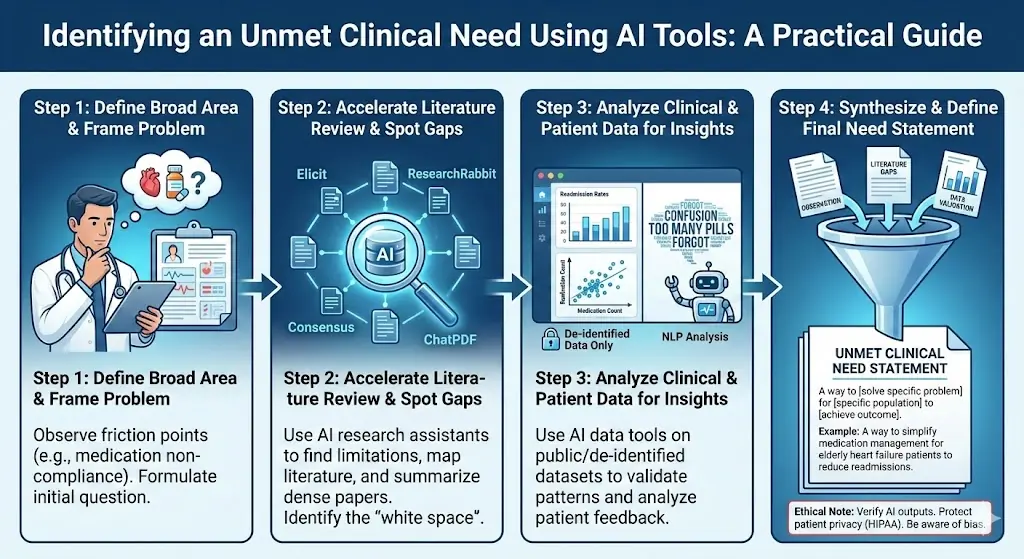
Identifying an unmet clinical need is the first and most critical step in medical innovation. Every day in hospitals, clinicians and students encounter delays, confusion, inefficiencies, and patient suffering that gradually become normalized. These routine frustrations such as long waiting times, poor patient understanding of instructions, loss of follow-up, or excessive paperwork are actually signals of deeper problems in healthcare delivery. An unmet clinical need is a gap where no effective, affordable, or scalable solution exists, and recognizing this gap requires careful observation of real clinical workflows.
Artificial Intelligence (AI) tools can help transform these daily observations into structured problem statements. Instead of keeping frustrations vague, clinicians can use tools like ChatGPT, Claude, or Gemini to convert raw experiences into well-defined unmet needs. For example, a simple observation such as “patients forget post-operative instructions” can be reframed into a need statement like “there is no simple and personalized system to reinforce post-operative care instructions for surgical patients.” This shift from complaint to structured need creates a foundation for innovation and research.
Once a problem is defined, it must be validated scientifically. AI-powered literature tools such as Elicit, Research Rabbit, Consensus AI, and Semantic Scholar allow users to quickly explore existing research and current solutions related to the problem. These tools summarize findings, highlight limitations, and identify gaps in evidence. If existing solutions are too expensive, unavailable in low-resource settings, poorly adopted, or ineffective, the problem qualifies as a genuine unmet clinical need. This step prevents duplication and ensures that innovation is based on evidence rather than assumption.
Understanding where exactly the problem occurs within the clinical process is equally important. Workflow-mapping tools such as Miro AI, FigJam AI, and Whimsical can be used to visualize each step of patient care and identify points where failure or confusion happens. For instance, mapping the discharge process may reveal that patients receive instructions only once, in a rushed environment, without reinforcement or follow-up. This clarity allows innovators to focus on precise gaps instead of designing broad or unrealistic solutions.
To assess whether a problem is worth solving, its frequency and impact must be measured. AI-assisted surveys created using Google Forms, Typeform, or Excel Copilot can collect feedback from doctors, nurses, and patients. Tools like BigML or Orange Data Mining can then analyze these responses to reveal patterns, trends, and priority areas. This process converts personal opinion into data-driven insight, ensuring that the chosen problem is both common and clinically important.
A critical part of unmet need identification is understanding the user. AI tools such as ChatGPT and Notion AI can generate patient and healthcare worker personas that describe their challenges, emotions, limitations, and daily realities. For example, an elderly patient in a government hospital may struggle with literacy, language, and smartphone access. These personas help innovators remain human-centered and prevent solutions that are technologically impressive but practically unusable.
AI can also be used to explore innovation directions rather than jumping directly to product design. By prompting AI to suggest solution approaches such as workflow redesign, educational tools, digital reminders, or low-cost assistive systems clinicians can examine multiple possibilities before committing to one. This encourages creativity while staying grounded in clinical reality. Importantly, this stage focuses on solving the problem rather than building a specific app or device.
Ethical and feasibility considerations must be integrated from the beginning. AI tools can help identify potential risks such as data privacy violations, bias, overdependence on technology, and patient safety concerns. Prompting AI to list ethical safeguards ensures that innovation remains responsible and aligned with medical values. Any unmet clinical need identified using AI must be approached with transparency, consent, and patient welfare as priorities.
In practice, a simple example illustrates this process clearly. A clinician may notice that many post-surgical patients fail to return for follow-up visits. Using AI tools, this observation can be converted into a structured unmet need, validated through literature and surveys, mapped within the care workflow, and analyzed through patient personas. The final unmet need might be stated as “there is no affordable and personalized follow-up support system for post-surgical patients in public hospitals.” This statement becomes the starting point for meaningful innovation.
Overall, AI transforms unmet clinical need identification from a random, intuition-based exercise into a systematic and evidence-driven process. It helps clinicians observe more clearly, validate more quickly, and think more creatively while remaining human-centered and ethical. Instead of beginning with the question “what product should we build?”, innovators begin with “what real clinical problem must we solve?”. In this way, every ward round becomes a learning opportunity, every frustration becomes an innovation seed, and AI becomes a lens that sharpens clinical insight into actionable healthcare solutions.
#MedicalInnovation #UnmetClinicalNeed #HealthcareInnovation #AIinHealthcare #ClinicalResearch #DesignThinking #DigitalHealth #HealthTech #MedEd #EvidenceBasedInnovation #HumanCenteredDesign #AIforDoctors #MedicalStudents #HealthcareLeadership #InnovationInMedicine