
Most people don’t notice design in healthcare.
Not because it isn’t there — but because when it works well, it becomes invisible.
From the layout of a pill strip to the sound of a monitor, healthcare systems are filled with small, intentional decisions. Yet, these details are often overlooked — by patients and sometimes even by professionals.
This raises an important question:
Why do critical design details go unnoticed in environments where they matter the most?
The Case: A Simple Medication Routine
Consider a common scenario.
A patient is prescribed a once-daily medication. They are given a standard blister pack — identical pills, uniform layout, minimal visual cues.
By midweek, a familiar doubt sets in:
“Did I take my pill today?”
This moment of uncertainty is small — but significant.
It can lead to:
- Missed Doses
- Double dosing
- Anxiety and lack of confidence in treatment
Not because the medication failed — but because the design didn’t support the user.
What Went Unnoticed
At first glance, the blister pack appears functional. It holds the medication securely, maintains hygiene, and is easy to carry.
But look closer, and the gaps become clear:
- No indication of sequence (which pill to take next)
- No time-based guidance (morning/evening/day-wise)
- No differentiation between consumed and unconsumed doses
The design assumes memory, consistency, and attention — all of which are unreliable in real life.
The Design Intervention
Now imagine a redesigned version of the same blister pack.
- Each pill is labeled with days of the week
- Arrows guide the sequence of consumption
- Visual cues clearly show what has been taken and what remains
Nothing about the medication changes. But everything about the experience does.
The patient no longer has to remember. The design does the thinking for them.
Why These Details Are Missed
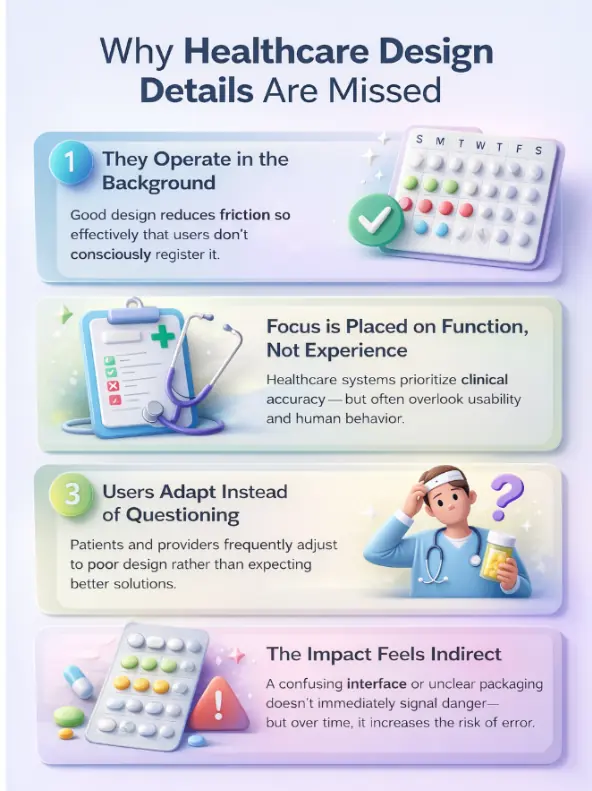
This is where the deeper insight lies. Healthcare design details are often missed because:
- They Operate in the Background: Good design reduces friction so effectively that users don’t consciously register it.
- Focus is Placed on Function, Not Experience: Healthcare systems prioritise clinical accuracy — which is essential — but often overlook usability and human behaviour.
- Users Adapt Instead of Questioning: Patients and providers frequently adjust to poor design rather than expecting better solutions.
- The Impact Feels Indirect: A confusing interface or unclear packaging doesn’t immediately signal danger — but over time, it increases the risk of error.
The Real Cost of Overlooking Design
When design details are ignored, the consequences are subtle but serious:
- Increased cognitive load for patients and healthcare providers
- Higher chances of human error
- Reduced adherence to treatment plans
- Lower trust in healthcare systems
These are not failures of medicine. They are failures of design integration.
Rethinking Healthcare Through Design
The future of healthcare isn’t just about better technology or advanced treatments.
It’s about designing systems that align with how people actually behave — especially in moments of stress, fatigue, or uncertainty. Because in healthcare:
- People forget
- People rush
- People make mistakes
Design exists to account for that.
The most effective healthcare designs are not the ones that stand out — but the ones that quietly guide, support, and prevent errors.
They don’t demand attention. They reduce the need for it.
And perhaps that’s why they are so often missed.
But when we begin to notice these details, we start to see healthcare differently — not just as a system of treatment, but as a system of thoughtfully designed experiences.
#systems #design #usercentric #designthinking #MedTech #engineering #medical #interdisciplinary #GGMC #JJH #InnovateToEvolve